
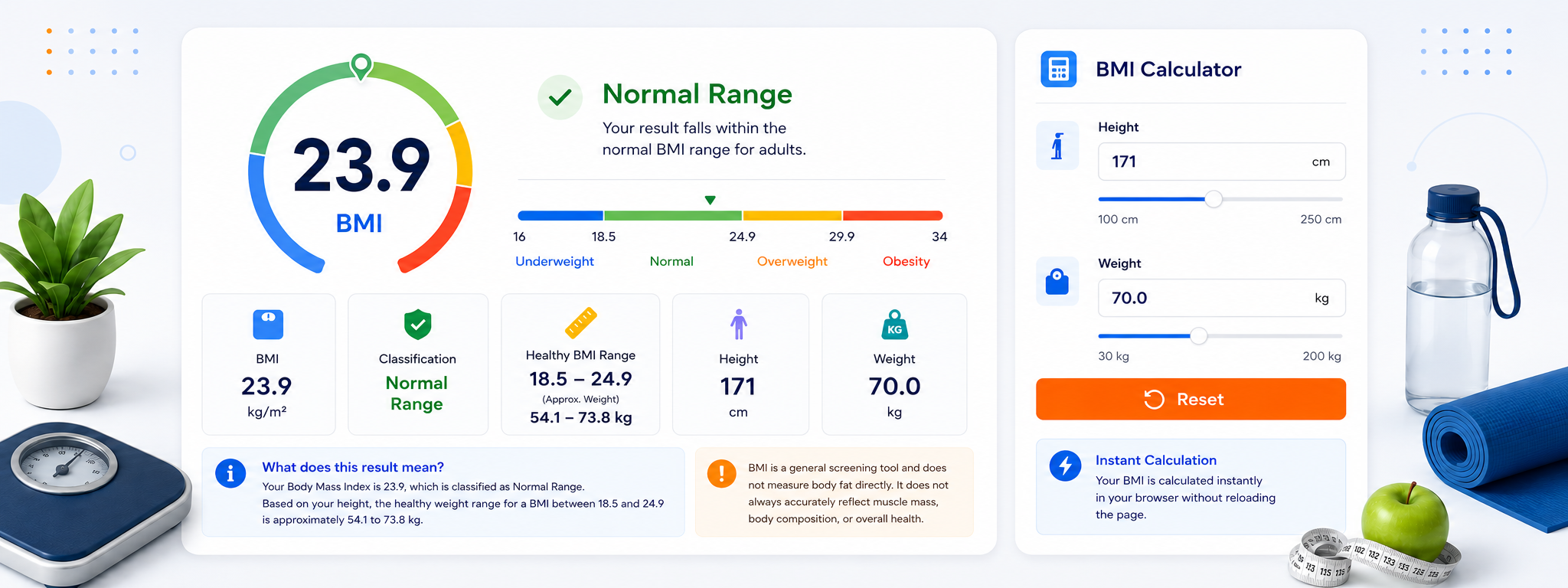
Calculate your BMI and understand the category behind the number
Body Mass Index, or BMI, is a simple calculation that relates your weight to your height. It is widely used as a first-line screening measure for adult weight categories. Enter your height in centimeters and your weight in kilograms, and the calculator will show your BMI along with the category associated with that result.
The page goes beyond a single number. It shows the BMI range your result falls into and estimates the weight range associated with the commonly used adult BMI range for your height, making the result easier to interpret at a glance.
The important part is context: BMI is a screening estimate, not a medical diagnosis. It does not directly measure body fat, and it cannot distinguish fat from muscle or bone. For that reason, it should not be used on its own to describe overall health or body composition.
What is Body Mass Index (BMI)?
BMI is a ratio calculated from weight and height squared. It is commonly used as a simple screening tool for adult weight categories, but it does not directly measure body fat or provide a diagnosis of a person's health.
It uses height and weight
No complex measurements are required. The calculator only needs your height and weight to calculate the index.
It produces a standardized number
The number places weight within commonly used adult ranges rather than looking at kilograms alone.
It is a screening tool
BMI can be a useful starting point for discussing weight and health, but it is not enough to assess an individual by itself.
It does not measure body-fat percentage
Two people with a similar BMI can have very different amounts of muscle, fat, and overall body composition.
It does not show where body fat is stored
BMI does not describe fat distribution, waist circumference, or visceral fat, all of which may matter in a broader health assessment.
It needs context
Age, medical history, body composition, clinical assessment, and other factors may all be relevant when interpreting the bigger picture.
How is BMI calculated?
Using metric units, BMI is calculated by dividing weight in kilograms by height in meters squared.
What does your BMI number mean?
For adults, commonly used BMI ranges group results into underweight, the usual weight range, overweight, and obesity. These categories are screening classifications, not diagnoses in themselves.
| BMI | Adult category | How to read it |
|---|---|---|
| Below 18.5 | Underweight | The result falls below the commonly used adult weight range. |
| 18.5 to 24.9 | Within the usual range | The result falls within the commonly used adult BMI range. |
| 25.0 to 29.9 | Overweight | The result is above the usual range and below the obesity range. |
| 30.0 and above | Obesity | The result falls within the obesity range in adult BMI classifications. |
What does the BMI calculator show after you enter your details?
Instead of stopping at the BMI number, the page brings together the details that help explain what the result means and which measurements were used to calculate it.
BMI value
The number calculated from your height and weight, such as 23.9 for someone who weighs 70 kg and is 171 cm tall.
Category
Shows which commonly used adult BMI category contains your result.
Entered height
Displays the height used in the calculation so you can quickly check for an input or measurement error.
Entered weight
Shows the weight used in the formula, making the result easier to verify.
Usual adult BMI range
Shows the 18.5 to 24.9 range commonly used as the usual adult BMI category.
Weight range associated with your height
Converts the 18.5 to 24.9 BMI range into an approximate weight range for the height you entered.
What does the weight range associated with BMI mean?
When the calculator shows a weight range linked to BMI values from 18.5 to 24.9, it is converting those BMI limits into weights that correspond to your height. It does not mean there is one ideal weight for every person, nor does being inside the range guarantee good health.
What does BMI not tell you?
BMI is useful because it is quick and simple, but that simplicity also creates its limitations. The number cannot explain body composition or overall health on its own.
BMI does not distinguish between fat, muscle, and bone, so it may not describe body composition well in people with high muscle mass.
It does not show where body fat is stored and does not measure waist circumference or visceral fat.
It does not diagnose disease or determine an individual's fitness, nutrition status, or health risk by itself.
If the result concerns you, or you have a medical condition or a noticeable change in weight, a fuller assessment from a qualified health professional is more useful than relying on BMI alone.
Can adult BMI ranges be used for children and teenagers?
No. BMI for children and teenagers is not interpreted using the same fixed adult cutoffs. Assessment depends on age, sex, and growth percentiles. If a calculator uses only height and weight, its direct adult categories should not be treated as a substitute for pediatric growth assessment.
How do you use the BMI calculator?
The calculation is simple, but accurate height and weight measurements matter because input errors affect the result directly.
Enter your height
Enter your measured height in centimeters. Measuring without shoes can help keep the value closer to your actual height.
Enter your weight
Enter your weight in kilograms and make sure the unit is correct.
Review the BMI and category
Read the BMI number together with its category and range rather than relying on the number alone.
Read the explanation before saving
Review the BMI limits and interpretation notes, then use PDF, image download, copy, or share options if needed.
Simple tips for a more consistent calculation
Use a recent, properly measured height because height is squared in the BMI formula and measurement errors can have a noticeable effect.
If you are tracking change over time, try to weigh yourself under similar conditions instead of comparing random measurements taken at different times of day.
Do not treat a very small change in BMI as a major health change. The number moves directly with changes in weight.
Use BMI as one part of a broader picture that can include your medical history and other factors discussed with a doctor or qualified health professional when appropriate.
PDF, image, copy, or share
Once you have reviewed the result, you can save it in the format that suits you, whether for personal tracking or to keep alongside your own notes.
Export as PDF
Saves the result in a separate file that you can open again later.
Download as an image
A convenient way to keep a clean visual snapshot of the result on your phone or computer.
Copy the result
Copies the BMI value, category, and key details to your clipboard.
Share
Lets you send the result using the sharing options supported by your device without retyping the details.
Frequently asked questions about the BMI calculator
How is BMI calculated?
What is the usual adult BMI range?
Does BMI measure body-fat percentage?
Is a BMI result a medical diagnosis?
Can a high BMI be caused by muscle?
Does the displayed range mean my ideal weight?
Can adult BMI categories be used for children?
Why does the weight range change with height?
When should I discuss the result with a health professional?
You may also find these useful
Continue with a related calculator, or return to the full calculator collection to explore more everyday tools.